Reminders and debt collection
With our partner Debtist you take care of unpaid amounts, from the first dun to legal enforcement. You hand over open claims with one click.
On this page
- What is a claim?
- Activate debt collection
- Work on claims
- Start debt collection
- Dun first, then collection
- Close a claim
- When Debtist needs feedback
- Debt collection autopilot
- Costs
- FAQ
- Who is Debtist?
- Who appears as the creditor?
- In which countries is debt collection available?
- Which currencies are supported?
- What do I need for a successful claim?
What is a claim?
A claim arises when money from an order is missing. This mainly happens in three cases:
- An installment of an installment payment was not paid.
- A payment was disputed and reversed, also for subscriptions and installment payments. See Refunds and chargebacks.
- A SEPA direct debit failed. See SEPA direct debit failed.
Such orders automatically appear under Claims in the menu. At the top you see the totals of your Open claims, the amounts Forwarded to collection and what has already been Paid out.
Activate debt collection
Before you can hand over claims, you activate the debt collection service once:
- Open Claims.
- Enter your bank details under Account number/IBAN. Outside the EU, enter your account number and also the SWIFT/BIC Code.
- Read the terms and fees of Debtist and click Accept Debtist terms.
Debtist pays out the collected money to this account. With your consent, Tentary also passes your billing address on to Debtist. If you have not entered one yet, add it under Billing address first.
Work on claims
You can filter the list of claims:
- Not in collection: Open, Dun or Done.
- In collection: All, In progress, Feedback required or Done.
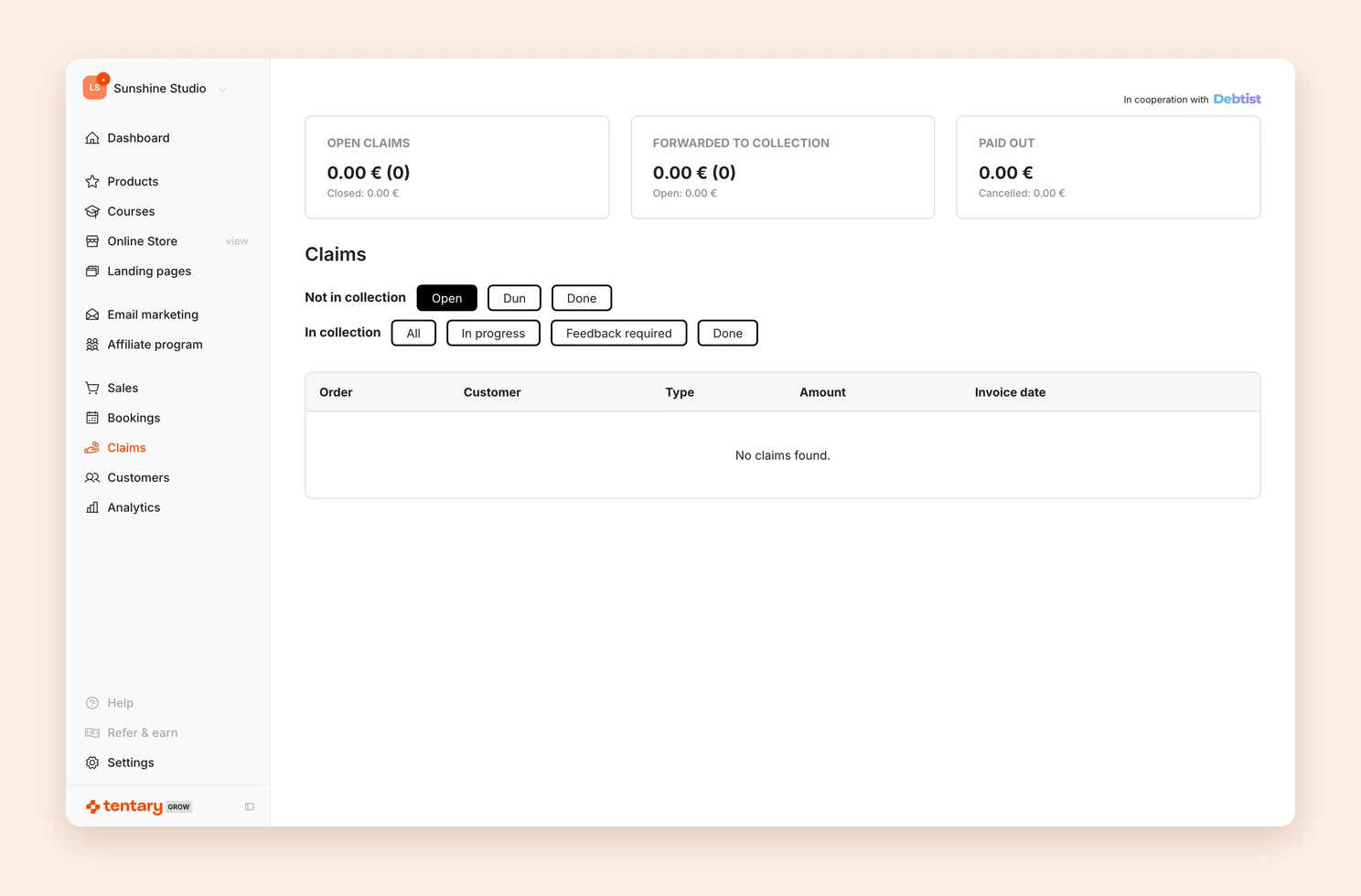
Click a claim to open its details with amount, product, buyer type, documents and history. From there, these steps are available depending on the case.
Start debt collection
Check the details and click Start Debt Collection. Debtist then takes over the claim and handles the next steps on your behalf, from the payment reminder to legal enforcement. Afterwards you can send Debtist further information and files about the case.
Dun first, then collection
For private customers, a dun with a 30-day deadline must be sent first in two cases: after a chargeback, and when the first SEPA direct debit failed. Click Start dun process. Tentary sends the dun, and once the deadline has passed, the claim automatically goes to Debtist. Send dun again sends the dun once more if needed.
Close a claim
If you have settled the matter with your customer in another way, click Close Claim. The claim is then not handed over to Debtist. Reopen Claim brings it back.
When Debtist needs feedback
If Debtist needs information from you, the claim has the status Feedback required. Read the comments in the history and reply under Feedback to Debtist. You can also upload files there. In addition, you receive a daily email with all updates, for example cases waiting for your reply and incoming payments.
Debt collection autopilot
With the autopilot, your claims go into the dunning process and debt collection automatically. To turn it on, click Autopilot inactive on the Claims page and confirm.
For each claim the autopilot is about to hand over, you receive an email. From then on you have 24 hours to close the claim if it should not go to debt collection.
Costs
For the first steps, you generally have no costs. Debtist keeps the statutory fees under the German Lawyers’ Remuneration Act (RVG), which are charged to the debtor on top.
Later in the process, third parties may charge costs, for example court fees. Debtist only takes such steps after consulting you. If you withdraw a claim on your own, a fee may apply. You find the details in the terms and price list of Debtist.
FAQ
Who is Debtist?
Debtist is our partner for receivables management. Debtist handles a claim from the first payment reminder to legal enforcement and has a high success rate.
Who appears as the creditor?
You do. Just as you sell your products on Tentary in your own name, you also act as the creditor for your claims.
In which countries is debt collection available?
Your customers can be from any country. You yourself need to be based in one of these countries: in the EU except France, in Switzerland, Liechtenstein, Norway, Iceland, Turkey, several Western Balkan countries, the United Arab Emirates, the USA, Canada, Australia, New Zealand or Japan. Debt collection is currently not available from the United Kingdom.
Which currencies are supported?
Euro, US dollar, British pound, Swiss franc, Polish złoty, and Danish, Norwegian and Swedish krone.
What do I need for a successful claim?
A name and email address are enough in principle, but the chances of success are low. If you sell more expensive products or expect payment defaults, ask for a billing address with every purchase. See Invoicing for sales.
Last updated October 14, 2026